
Equity Guard EA 8.3 — start here
Equity Guard EA is MeetAlgo’s account-level management tool for MT4 and MT5 Pro. It monitors configured conditions and can close captured market trades, delete captured pending orders, remove configured external EAs by applying templates, and send alerts. It does not open your trading strategy’s entries.
Important: automatic market closing is supported on MT4 and MT5 hedging accounts only. MT5 netting/exchange market positions are refused and can leave the event on HOLD. A trigger is not a guaranteed execution price or maximum loss. Other terminals, manual trading and unconfigured EAs can still open trades.
This guide describes version 8.3. Input names below match that release; text in parentheses such as ProfitValue identifies the saved-setting name when the on-screen caption differs. Screenshots are real supplied examples, not proof of defaults or live results.
1. Install, activate, then choose your first reference
- Install the matching MT4 or MT5 Pro file in the terminal’s Experts folder. Use a separate chart for Equity Guard, not the chart carrying the EA you want it to remove. Start on a demo account and review existing exposure first.
- Complete the product’s licensing step. Serial Key (
SerialKey, default blank) is the shared registration input; use the key supplied for your entitlement. For online activation, the WebRequest allowlist must include exactly https://lic.meetalgo.com/, including the trailing slash. Never share your key in a screenshot. - Allow algorithmic trading and the permissions required for the selected actions. The initial-equity panel appears only after product validation and registration allow access. If you still see activation information, resolve that before equity setup.
- Open Inputs and configure the trigger, its action switches, the matching Action sections and After Actions. Do not assume the defaults are inactive: the default equity-profit target is 2 account-currency units and trade closing/deletion are enabled.
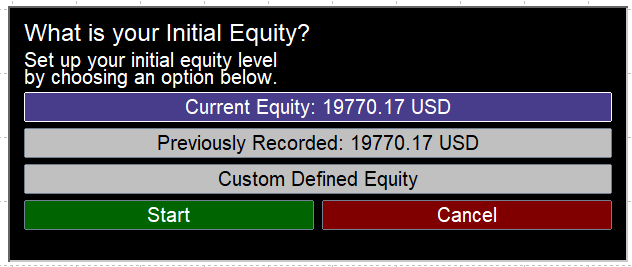
- In What is your Initial Equity?, choose one of the options below. This is a chart panel, not another input category.
- Click Start explicitly. If a condition already matches, read every safety-review page and the selected actions before choosing Start Anyway. Changing conditions can require a fresh review. Missing required history/data can block Start. Cancel removes this Equity Guard instance only; it does not close trades or restore external EAs.
- Check the actual EA Status and Recorded Equity. Keep the terminal connected and running. Verify the intended behavior on demo before relying on it.
Installation and licensing help
The shared installation and licensing guides explain the account/download process. Follow your actual entitlement; example activation counts in older help articles are not your entitlement. Equity Guard’s activation-first setup and canonical online URL above take precedence for this version.
Choose one initial-equity option
| Panel choice | What it does |
|---|---|
| Current Equity | Uses the current positive account equity when you start. |
| Wait Until No Market Trades | Offered while market trades exist; starts with Recorded Equity = 0 / WAIT. When the account has no market trades, records current equity. Pending orders do not block capture. This is the initial default selection when available; otherwise the panel falls back to Current. |
| Previously Recorded Equity | Offered only when a readable, positive saved reference exists in this terminal for this account number. Select it deliberately; a restart does not automatically resume the old workflow. |
| Custom Defined Equity | Enter a finite positive decimal, using digits and a decimal point only, such as 1000.00. No currency symbol, commas or minus sign. Review any immediate-trigger warning. |
2. Understand the cycle before setting thresholds
Start with one reference choice. After that, Equity Guard follows the repeating workflow below—it does not reopen the initial-equity panel after every trigger.
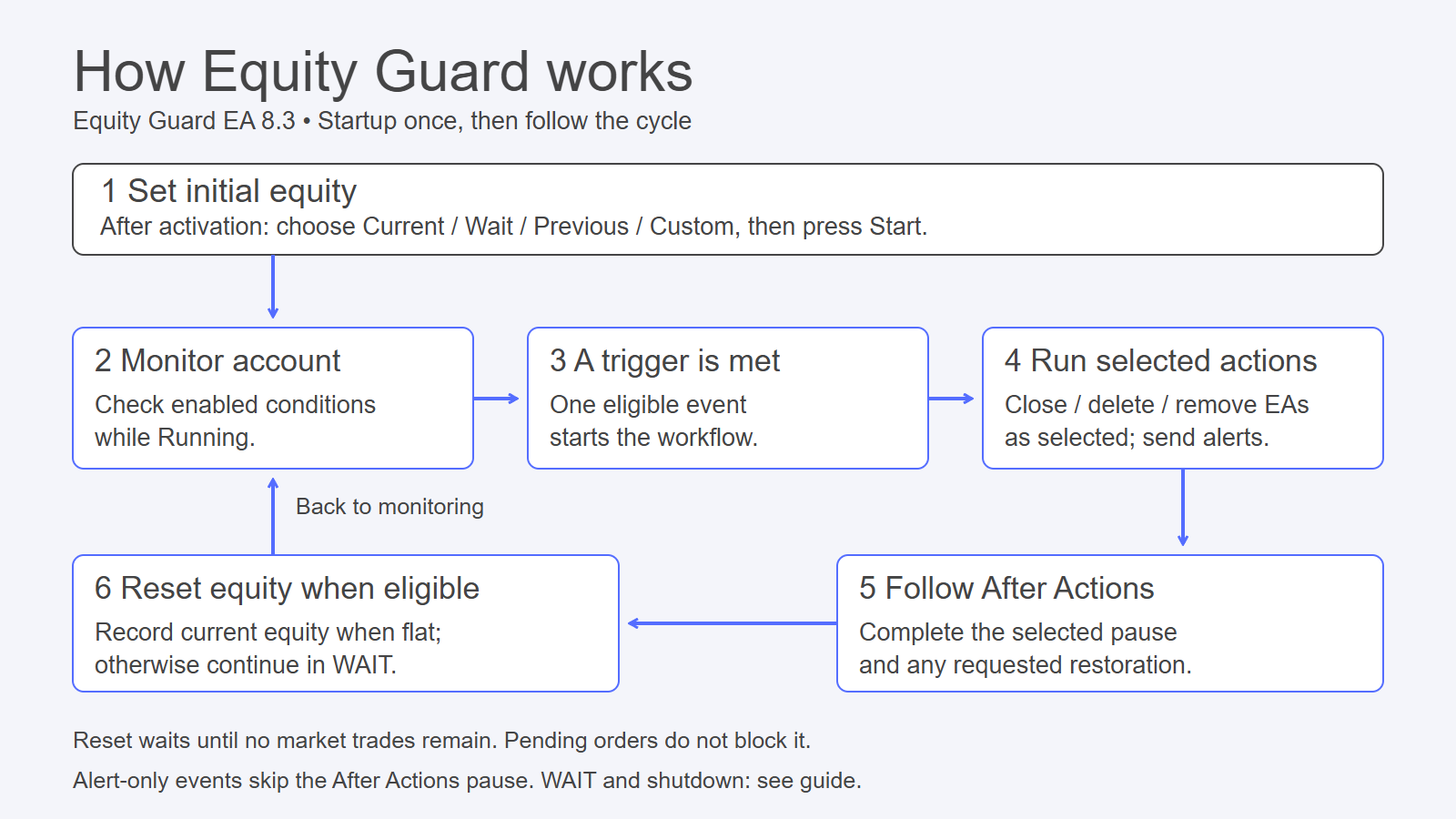
- Set initial equity — once at startup. After activation, choose your initial reference and press Start. Current, Previous and Custom supply a positive reference; Wait starts at zero until no market trades remain. This is separate from the daily drawdown references.
- Monitor account. While Running, check enabled conditions using their required references and data. WAIT blocks only the conditions that need a positive Recorded Equity; independent conditions can still be checked.
- A trigger is met. One eligible event starts the workflow. If several conditions match, the earlier eligible condition can take priority; they are not all executed simultaneously.
- Run selected actions. Capture the event’s settings, tickets and charts, then perform only its selected closing/deletion and external-EA removal tasks. Send alerts through enabled channels. Later trades are not added to the captured list.
- Follow After Actions. Complete the chosen pause or manual-reset gate and confirm any requested restoration. Processing, restoration and HOLD are not normal monitoring. If terminal shutdown is selected, the terminal cannot continue this loop while closed; see section 11.
- Reset equity when eligible. When the cycle completes, record current equity if no market trades remain. Otherwise the reference becomes zero / WAIT. Return to monitoring under the normal gates; independent conditions remain available during WAIT. When the account is market-flat, capture the next reference. The loop returns to step 2, not the initial choice.
WAIT checklist: Recorded Equity = 0 means the relative profit, relative loss and Max Equity DD conditions cannot calculate. It does not switch off independent absolute-equity, daily-reference, period P/L, time or news conditions after Start. Pending-only accounts can record a reference. If a completed cycle leaves later market trades open, the next reference remains zero / WAIT until flat.
Alert-only exception: if a trigger has no effective market-close, pending-delete or external-removal action, it does not apply an After Actions pause or shutdown. It completes its cycle/reset path and continues. Alerts still require an enabled channel; all channels default off. Do not use an alert-only event as a trading lock.
Two reset modes, not four
Equity Reset Type (Equity_Reset) defaults to No Order. Version 8.3 supports only:
- No Order: after the first completed cycle, refreshes the reference on eligible running passes while there are no market positions. When positions exist, an established reference stays until the cycle/reset rules require WAIT.
- After Trigger Hit (No Order): after a completed trigger → actions → After Actions/restoration cycle, waits for no market positions, then records current equity. It does not continuously refresh merely because the account remains flat.
First-cycle exception: your initial Current, Previous or Custom reference is preserved until the first complete cycle. Being flat does not immediately overwrite it. The Wait choice still captures when market trades finish. The old Last Equity and Highest Equity selectors are removed; legacy values must be replaced with a supported choice, not silently reinterpreted.
3. EA Configuration and operating controls
Stop EA (Stop_EA) defaults to false. Setting it to true blocks Start, monitoring and action/restoration processing and shows STOP By Input after setup. Set it back to false only after reviewing why the EA was stopped. A chart Run button cannot override this input.
The general configuration guide covers shared terminology. Equity Guard has no user symbol or magic-number filter for its account-wide closing scope; do not assume the general guide’s entry-EA settings exist here.
| Control or status | What to do / what it means |
|---|---|
| Green Stop EA button | While Running, manually pauses monitoring. It does not close trades, remove EAs or reset the recorded reference. |
| Red Run EA button / Stop | Resumes the same manually paused cycle and reference. Check the status row, not only button color. |
| Stop For Reset | The After Actions manual-reset choice is waiting. Run EA begins restoration/completion and the next reset path, unlike ordinary pause/resume. |
| Processing / Restoring | An event is being completed. The button is not an interrupt or an immediate new-cycle shortcut. |
| Timed/day pause | Wait for the selected duration or next broker D1 bar; the button cannot bypass it. No new trigger actions occur during this pause. |
| Running – WAIT | Independent conditions remain eligible, but the recorded-reference conditions await a positive reference. |
| HOLD | An action could not be safely confirmed. Inspect tickets, charts and Experts logs, resolve the cause, then use the status button’s bounded recovery. It retains the original snapshot; it does not adopt new tickets. |
| Invalid Settings | Correct the inputs. Monitoring/actions are blocked; a retained session is not proof the new settings are safe. |
Record Equity editing: after Start, the dashboard’s Record Equity field accepts a positive decimal only while normally Running, not manually stopped, not stopped by input and not in WAIT. Editing it changes the reference and can immediately make a condition match. It is not a way to erase unresolved action progress. The manual CLOSE ALL control asks for confirmation and uses the selected shared close/delete actions with an account-wide fixed snapshot; it is not an external-EA removal shortcut.
4. Trigger #1 — gain or loss from Recorded Equity
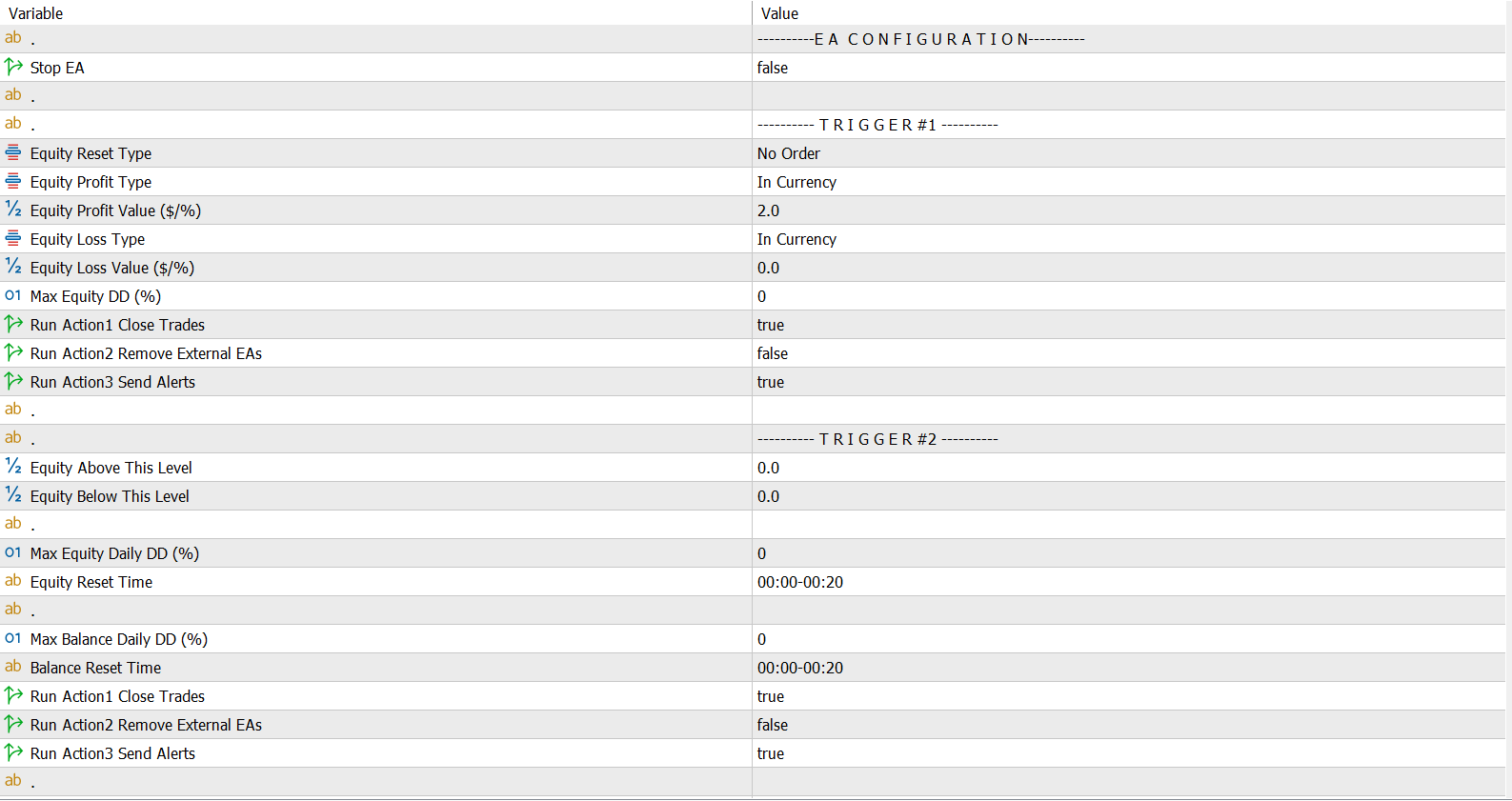
First choose the reset mode above, then set the profit/loss units and positive thresholds. Set an unused threshold to 0. Use nonnegative values; zero is the documented off value, not a reason to enter a negative target.
| Exact input label (identifier) | Default | Meaning |
|---|---|---|
Equity Profit Type (ProfitType) |
In Currency | In Currency means account deposit currency; In Percent means percent of Recorded Equity. |
Equity Profit Value ($/%) (ProfitValue) |
2 | Positive gain threshold. Fires when the positive equity change reaches or exceeds it. 0 disables profit targeting. |
Equity Loss Type (LossType) |
In Currency | Select currency or percentage independently of the profit setting. |
Equity Loss Value ($/%) (LossValue) |
0 | Positive loss magnitude. Fires when equity loss reaches or exceeds it. 0 disables. |
Max Equity DD (%) (EquityDD) |
0 | Integer percent drop from Recorded Equity, not a trailing peak-equity drawdown. 0 disables. |
Calculation: change = Current Equity − Recorded Equity. Percentage threshold in account currency = Recorded Equity × percentage ÷ 100. The engine rounds the relative change and percentage amount to two decimals. Currency labels containing $ do not convert a non-USD account into dollars.
Illustrative example, not recommended settings: reference 1,000, currency profit target 5 → a positive change of 5 reaches the target at equity 1,005. Reference 1,000 with a 5% loss/DD threshold → threshold amount 50, reached at equity 950. Actions can execute later and at different prices.
Choose actions independently for every trigger
Each of Triggers #1, #2, #3 and #4 repeats the same three labels. Set them within the group whose condition you want to use:
| Repeated input label | Defaults in all four groups | What it enables |
|---|---|---|
Run Action1 Close Trades (CloseTradesOnTrigger1 … CloseTradesOnTrigger4) |
true | Gates both shared Close all Open Trades and Delete all Pending Orders, not just market closing. |
Run Action2 Remove External EAs (RemoveExternalOnTrigger1 … RemoveExternalOnTrigger4) |
false | Uses enabled external chart groups in Action #2. It does not mean “remove Equity Guard.” |
Run Action3 Send Alerts (SendAlertsOnTrigger1 … SendAlertsOnTrigger4) |
true | Uses the channels selected in Action #3; it does not turn those channels on automatically. |
An old preset enabling an external chart group still needs its intended trigger’s new Run Action2 switch enabled. Chart group numbers are not trigger numbers.
5. Trigger #2 — absolute equity and daily reference floors
- For an absolute ceiling/floor, enter a positive Equity Above This Level (
EquityAbove) or Equity Below This Level (EquityBelow). Both default to0(off), in account currency. Above uses strictly greater than; Below uses strictly less than. Equality alone does not fire these two conditions. - For a daily reference floor, choose the appropriate daily-DD input and understand the accounting below. Both integer percentages default to
0(off). - Set that group’s action switches. Do not describe these settings as a firm’s official loss-rule engine.
| Exact label (identifier) | Default | Version 8.3 behavior |
|---|---|---|
Max Equity Daily DD (%) (EquityDaityDD) |
0 | Compares current account equity with the daily-equity-reference floor. |
Equity Reset Time (EquityResetTime) |
00:00-00:20 |
Broker-server-time window that refreshes the separate daily-equity reference; it does not reset Recorded Equity. |
Max Balance Daily DD (%) (BalanceDaityDD) |
0 | Also compares current equity, not current balance, with a floor based on the daily balance reference. |
Balance Reset Time (BalanceResetTime) |
00:00-00:20 |
Broker-server-time window that refreshes the daily balance reference. |
Read this before using daily limits: in the equity reset window, this release records account balance as the daily-equity reference. Outside the window, an unset daily-equity reference can initialize from equity when the account is market-flat. The daily balance reference comes from balance in its window, or while flat if still unset. These references are not persisted as a firm’s immutable start-of-day figures. Eligible timer passes refresh them throughout the window, rather than taking a single midnight snapshot. The reset window’s start is inclusive and end exclusive.
Floor = reference − rounded(reference × DD% ÷ 100); the final floor uses the attachment symbol’s configured digit precision. The trigger requires current equity below that floor. For an illustrative reference 1,000 and 5%, the floor is 950: equity exactly 950 does not meet this strict comparison, while 949.99 does.
Precedence limitation: when Max Balance Daily DD is enabled and its reference exists, its branch takes precedence and the daily-equity-DD branch is not evaluated, even if the balance-based floor has not been crossed. Do not assume enabling both creates two independent daily protections.
6. Trigger #3 — time and daily/weekly/monthly P/L
Time-based condition
- Active Close Trade By Time Zone (
CloseTradeByTime) defaults tofalse. Turn it on to enable the time condition. - Time Zone For Close Trade (
Trade_CloseTime) defaults to20:00 - 22:00, in broker server time, usingHH:MM - HH:MM. - Minimum Profit For Time Zone (
MinimumProfit_CloseTime) defaults to0: no floating-profit requirement, so a time event can realize a loss. A positive value requires current account-wide floating P/L at least that amount in account currency. A negative value is not a loss allowance. - The time condition can be claimed once per broker D1 period within the retained session. It is a trigger window, not continuous liquidation of every new trade opened in that window.
Time-window caution: the inherited closing-time helper checks hour/minute components separately. Windows with a nonzero starting minute or spanning midnight can behave unexpectedly; verify your exact window on demo rather than assuming continuous coverage. The default whole-hour daytime example is not evidence that every schedule is correct.
Period profit/loss conditions
| Exact labels (identifiers) | Default for each | Trigger comparison |
|---|---|---|
Max Daily Profit ($), Max Weekly Profit ($), Max Monthly Profit ($) (DailyMaxProfit, WeeklyMaxProfit, MonthlyMaxProfit) |
0 | Positive total P/L strictly greater than the enabled amount. |
Max Daily Loss ($), Max Weekly Loss ($), Max Monthly Loss ($) (DailyMaxLoss, WeeklyMaxLoss, MonthlyMaxLoss) |
0 | Negative total P/L whose loss magnitude is strictly greater than the positive amount. |
Set an amount above zero to enable; zero disables that condition. These are integer account-currency amounts, not percentages. Period P/L = qualifying closed trade P/L since the relevant broker D1/W1/MN1 bar opening + current floating trade P/L across the account. These periods follow the attachment symbol’s broker bars, not your computer’s calendar.
Closed P/L includes the profit, swap and commission fields read from qualifying records. MT4 uses closed buy/sell history; MT5 counts buy/sell deals with DEAL_ENTRY_OUT only. Therefore separately posted charges, entry-only commissions or other deal types are not necessarily included. Floating P/L uses the platform compatibility helper’s profit/swap/commission values; do not treat this as a complete broker-statement or prop-rule calculation. Deposits/withdrawals are not qualifying closed buy/sell P/L records, but they still change equity-based conditions.
Each period’s profit and loss condition has its own handled marker. Resetting Recorded Equity does not clear those markers during the retained session. MT4 must have loaded history reaching the requested period; MT5 must provide readable selected history. Missing history must not be treated as zero profit; inspect the diagnostic and load/check history before starting.
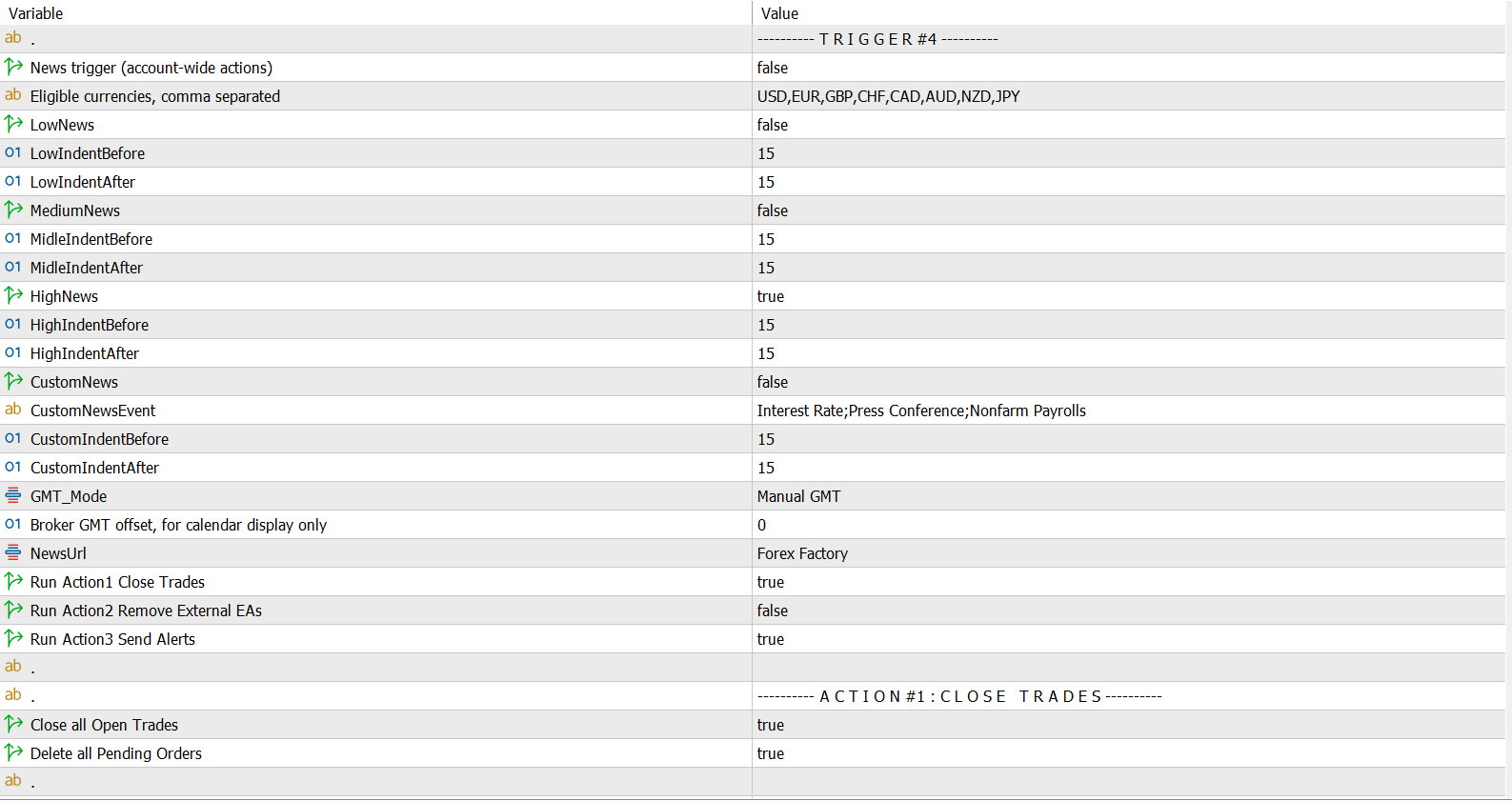
7. Trigger #4 — selected news windows
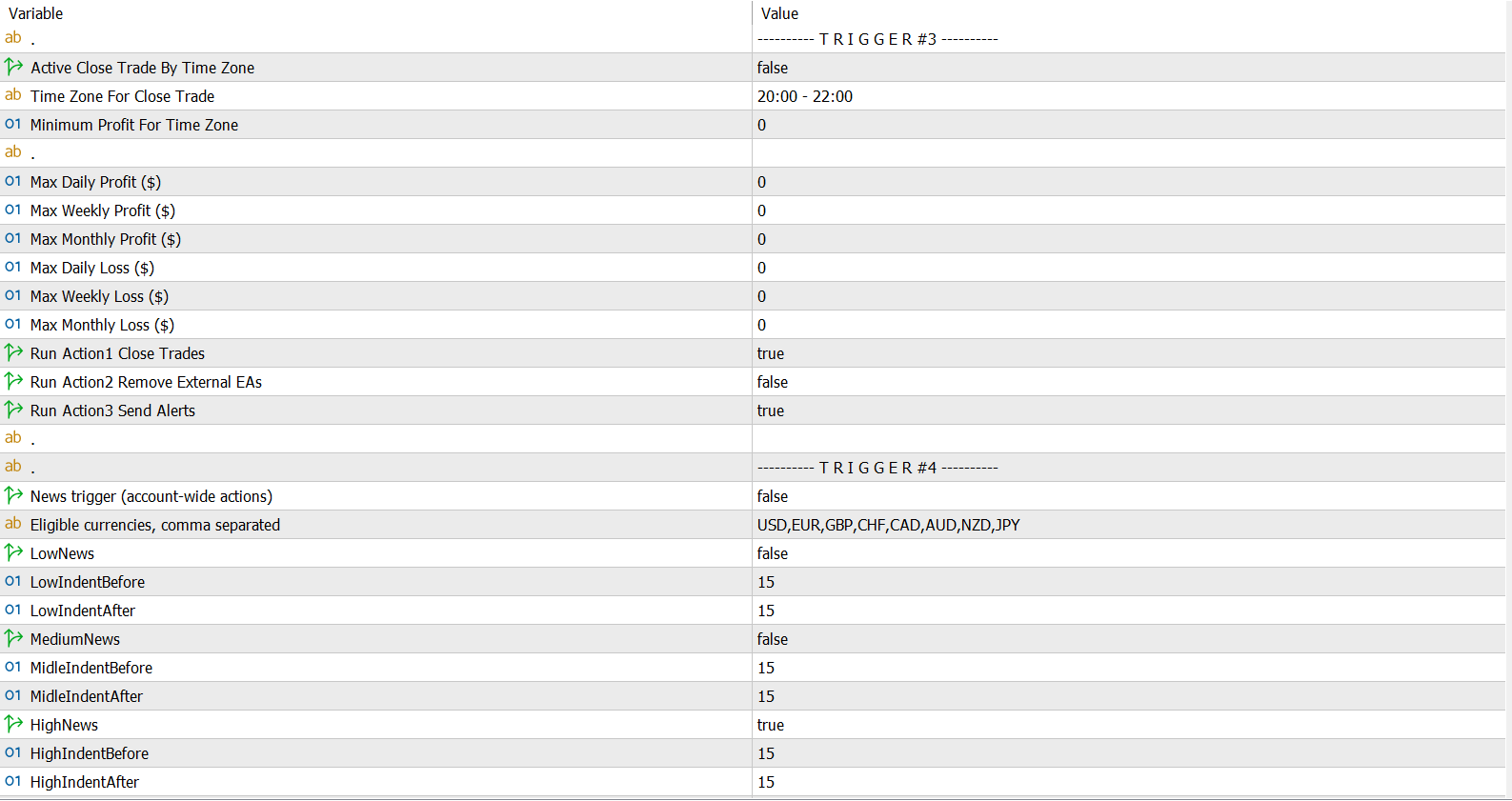
Equity Guard uses the shared calendar, but matched news triggers selected account-wide actions; it is not merely the common entry filter. Currency selection chooses events, not the trades to close. There is no chart-currency-only closure filter and no user news-line switch in this release.
- Set News trigger (account-wide actions) (
EnableNews) totruewhen you want news events; default isfalse. - Enter Eligible currencies, comma separated (
NewsSymbol). Default:USD,EUR,GBP,CHF,CAD,AUD,NZD,JPY. Keep the list nonempty; a blank list fails configuration validation even when news is off. - Choose impacts:
LowNews=false,MediumNews=false,HighNews=trueby default. Their before/after minute pairs areLowIndentBefore/LowIndentAfter,MidleIndentBefore/MidleIndentAfter(the spelling is intentional), andHighIndentBefore/HighIndentAfter. Each defaults to 15 minutes. - If needed, enable
CustomNews(defaultfalse) and editCustomNewsEvent(defaultInterest Rate;Press Conference;Nonfarm Payrolls). Keywords are semicolon-separated, case-insensitive substrings of the provider title. Matching still needs an eligible currency and a timed economic event with positive impact.CustomIndentBeforeandCustomIndentAfterdefault to 15 minutes each. If impact and custom rules both match, the larger before and after windows are used. - Select
NewsUrl: Forex Factory by default, or Investing.com. Allow the selected provider’s WebRequest base URL:https://nfs.faireconomy.mediaorhttps://sslecal2.investing.com. There is no automatic provider fallback. These calendar permissions are separate from the licensing URL. - Review
GMT_Mode(default Manual GMT, internalManual_Shift) and Broker GMT offset, for calendar display only (ManualGMTOffset, default0). Auto GMT is available for broker-offset detection. Equity Guard’s news trigger compares UTC event windows withTimeGMT(); these display-offset inputs do not move its trigger windows. Keep the PC clock correct. - Set Trigger #4’s three action switches and the shared Action/After Actions settings. Validate news delivery and event timing on demo. Ordinary Strategy Tester/optimization bypasses live news triggering.
All before/after minute inputs accept 0 through 525600 in configuration validation. Zero means no padding on that side, not “disable news.” Use a practical short window and test it; the broad accepted range is not a recommendation.
Illustrative window: a 14:00 UTC event with 15 minutes before/after is eligible from 13:45 through 14:15 UTC. Overlapping windows, including chains of overlaps, become one continuous zone and can trigger once in the current session. Ordinary resume/reference reset does not rearm the handled zone. A fresh restart clears the marker and can trigger again inside that zone. The window is not an enforced pause duration: After Actions controls the pause.
If usable calendar data is unavailable, the EA warns and creates no news action from the failure itself. Ordinary conditions remain eligible under their normal gates. No feed can be assumed permanently available.
8. Action #1 — close captured trades and delete pending orders
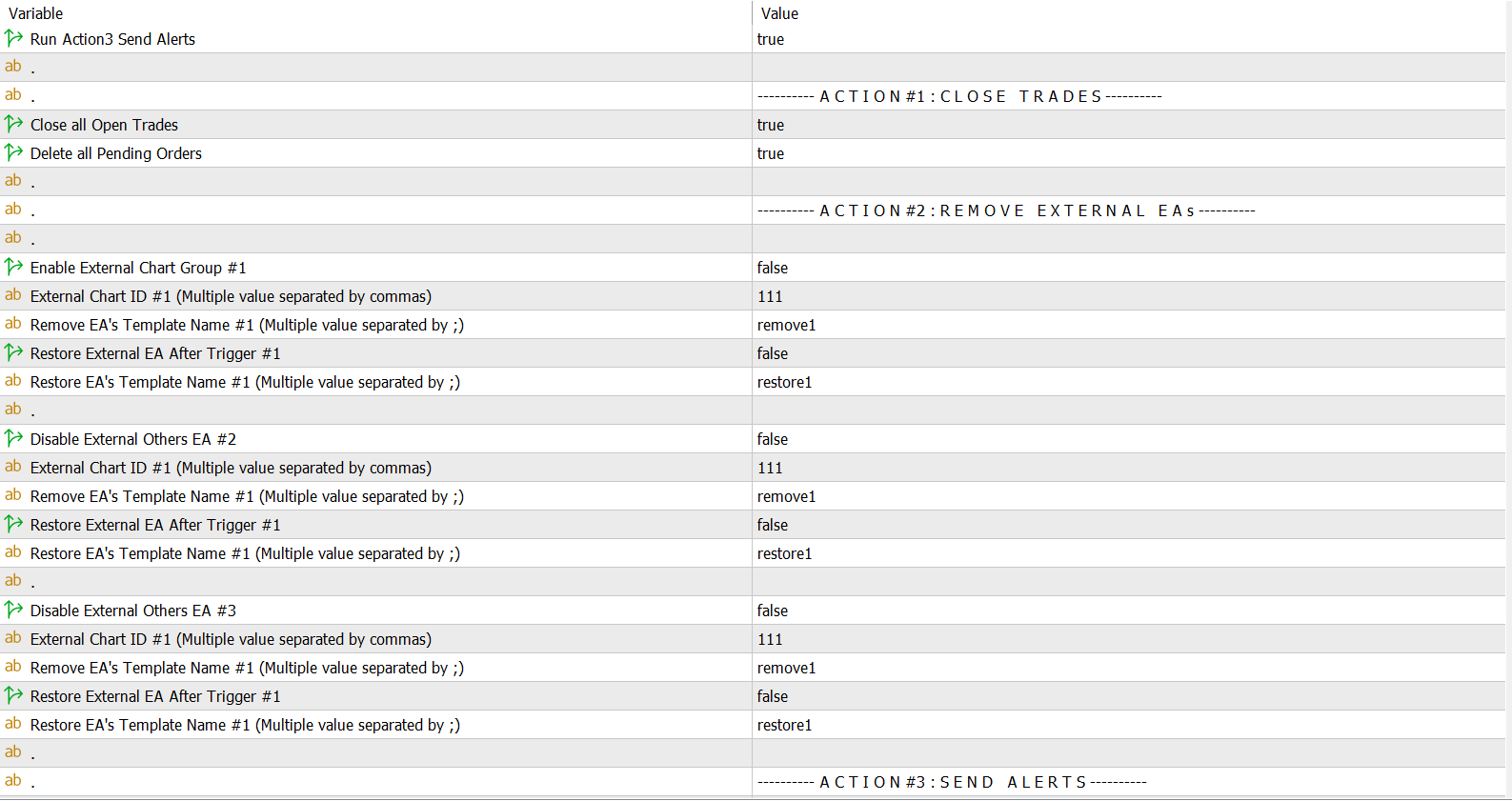
Close all Open Trades (CloseAllActiveOrders) and Delete all Pending Orders (DeleteAllPendingOrders) both default to true. Each runs only if the triggering group’s Run Action1 Close Trades is also true.
- Market closing is account-wide: all symbols and magic numbers, including manual and other-EA trades captured for that event. MT5 automatic market closure is hedging-only.
- Pending deletion is separate from market closing. Both use the fixed captured ticket list; MT5 pending collections include stop-limit orders.
- Trades/orders created later are not added during retries. A pending fill, changed exposure, ambiguous replacement or missing history may require HOLD instead of guessing identity.
- The event completes selected ticket tasks before removing external EAs. Broker confirmation matters; a sent request is not a completed close.
- Processing uses bounded rounds (five, with two-second pacing) rather than an endless close loop. Do not mistake the limit for a promise to finish in a fixed number of seconds.
Illustrative pending-only setup: enable the intended trigger’s Action1 switch, set Close all Open Trades=false and Delete all Pending Orders=true. Only captured pending orders are selected for deletion. This is an explanation, not a recommended trading preset.
9. Action #2 — configure external charts and templates
This is optional. Leave it off unless you have tested the exact charts and templates. Enable Run Action2 Remove External EAs in each trigger that should use it, then enable the required external chart groups here. All enabled chart groups are considered for that event; group #1 is not restricted to Trigger #1.
- Obtain the actual chart ID of each external EA chart using MeetAlgo’s Get Chart ID indicator. Do not use the default
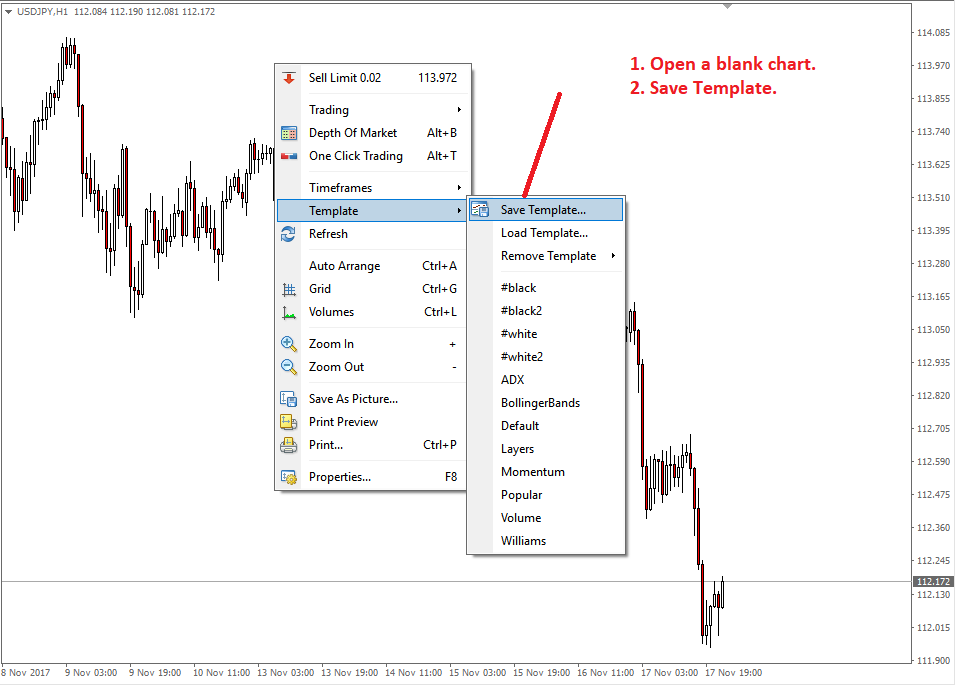
111, an account number or a copied example ID. Never target the Equity Guard chart. - Save a blank chart with no EA as a removal template, for example
remove1. Enter its name without.tpl. - If restoration is wanted, save the external EA with its intended inputs and permissions as a restore template, for example
restore1. Check the template carefully on demo: restoration can resume trading. - Enable the chosen group and enter its chart IDs and matching template names. Preserve filename case and avoid empty entries.
- Enable that group’s restore switch only when restoration is intended. Keep the captured chart’s symbol/timeframe and external EA identity unchanged until the workflow completes.
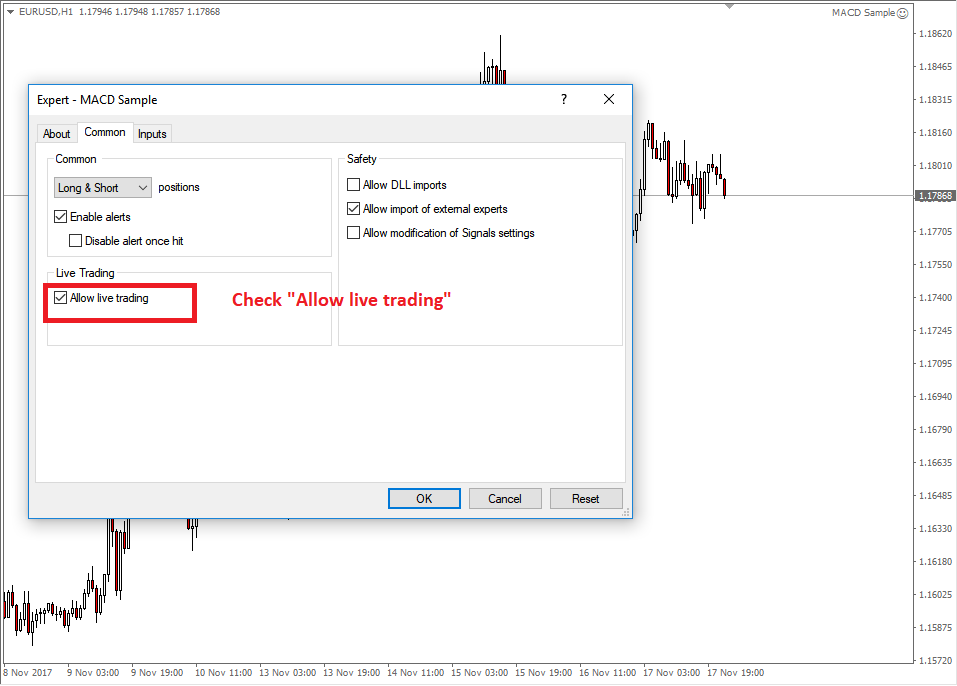
Version 8.3 exception to older template advice: a removal template that merely unchecks Allow live trading but leaves the external EA attached is not suitable for this workflow’s removal confirmation. The EA checks for an empty expert name. Use a genuinely blank/no-EA template; otherwise HOLD can result. Do not target another Equity Guard instance. Duplicate configured chart IDs are refused.
Get the external chart ID
Attach the MeetAlgo Get Chart ID indicator to each external EA chart, copy the displayed chart ID, then paste it into the intended group. These are the existing manual’s verified HTTPS downloads: Get Chart ID for MT4 and Get Chart ID for MT5. Download availability is not a new compatibility or execution test. Do not reuse somebody else’s chart ID.
Identify the three chart groups
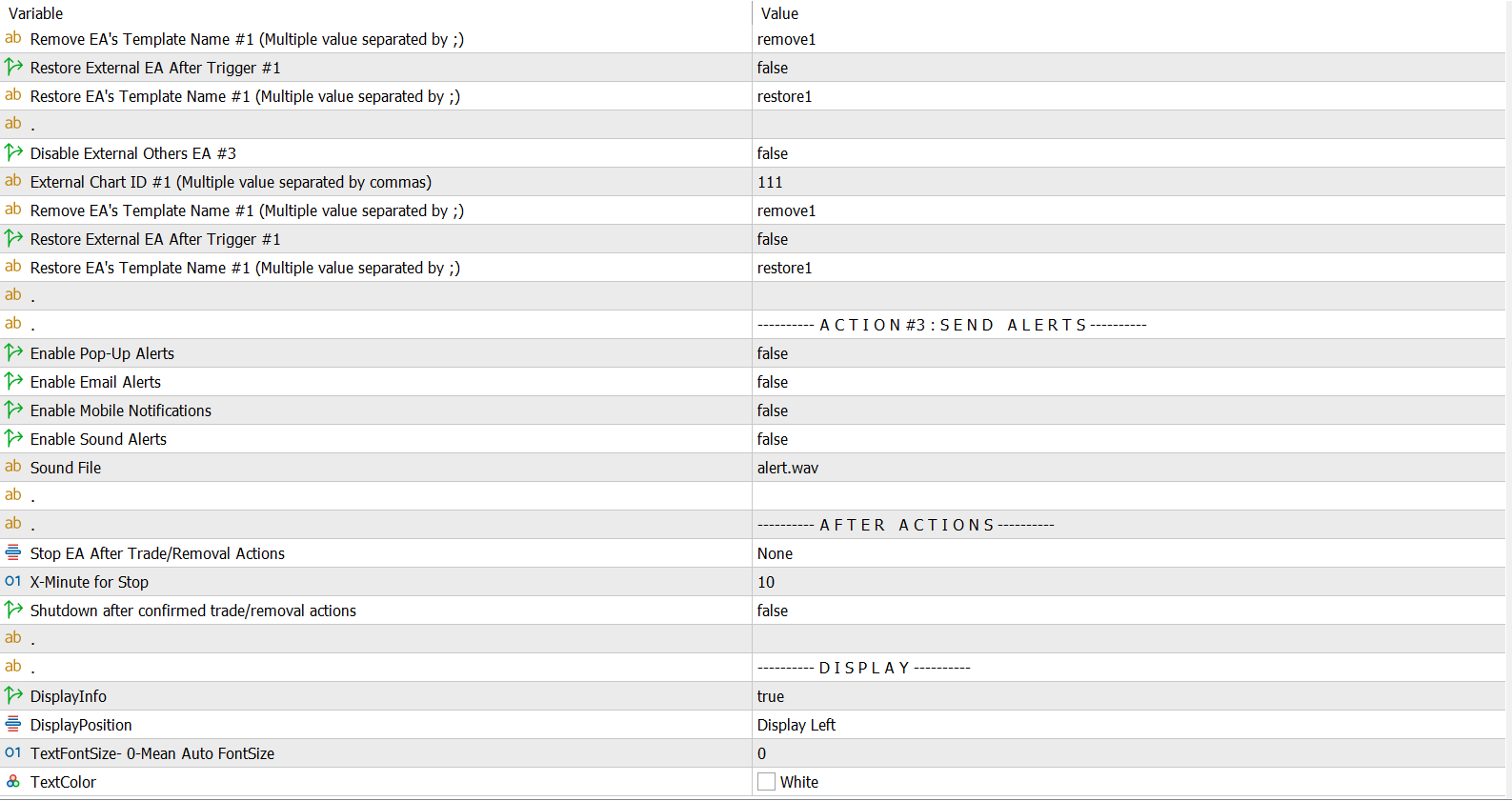
The on-screen labels for groups #2 and #3 contain older duplicated “#1” captions. Use their position and saved-setting identifiers to distinguish them:
- Group 1: Enable External Chart Group #1 (
DisableExternalEA1, default false). - Group 2: Disable External Others EA #2 (
DisableExternalEA2, default false). - Group 3: Disable External Others EA #3 (
DisableExternalEA3, default false). - Each has
External_Chart_ID1/2/3(default111),Template_Remove_Name1/2/3(defaultremove1),RestoreExternalEA1/2/3(default false), andTemplate_Restore_Name1/2/3(defaultrestore1). Restore labels saying “After Trigger #1” do not bind those groups to Trigger #1.
Separators: chart IDs accept commas or semicolons; the parser converts commas to semicolons and trims surrounding spaces. Removal and restoration template lists use semicolons, not commas. It appends .tpl itself. For multiple chart IDs, names are assigned by position; if there are fewer names than IDs, the last supplied name repeats. Prefer one shared name or a clearly matched list to avoid unintended reuse.
Illustrative mapping: for three of your own chart IDs, remove1;remove2;remove3 maps in order, and restore1;restore2;restore3 restores the third chart with restore3, not restore2. One remove1 is reused for all IDs. A single removal name with three restoration names is also supported. Example template names are not supplied presets.
Restoration is attempted only for captured removal tasks with restoration selected, after selected actions and the pause/reset gate. It requires the same chart identity and verifies the expected expert name. It cannot restore progress after a fresh restart, reopen a terminal or control other terminal installations. A template call being queued is not proof the EA was removed/restored.
10. Action #3 — select alert channels
The triggering group’s Run Action3 Send Alerts must be true, then select the channels needed:
| Exact input label (identifier) | Default | Purpose |
|---|---|---|
Enable Pop-Up Alerts (AlertSound) |
false | Terminal pop-up alert; the identifier is historical, not the sound-file switch. |
Enable Email Alerts (SendMailPossible) |
false | Uses the terminal’s configured email service. |
Enable Mobile Notifications (SendPush) |
false | Uses the terminal’s configured push/MetaQuotes ID settings. |
Enable Sound Alerts (UseSound) |
false | Plays the configured terminal sound. |
Sound File (SoundFile) |
alert.wav |
Sound filename; used when sound is enabled. |
Configure and test terminal email/push separately. A trigger notification does not confirm broker completion or successful restoration. Alert-only events do not apply After Actions pauses/shutdown.
11. After Actions — decide what happens next
Stop EA After Trade/Removal Actions (EA_Stop) defaults to None. It applies to effective trade/removal workflows, not alert-only/all-off events.
| Choice | Behavior after confirmed selected actions |
|---|---|
| None | No configured pause; restoration/completion still has to finish before the next cycle. |
| Stop EA For X-Minute | Pauses for X-Minute for Stop (X_Minute, default 10). Timing uses the computer’s local clock; allowed input range is 0–525600 minutes. A zero duration adds no timed wait. |
| Stop EA For This Day | Pauses until a newer D1 bar is available for the attachment symbol, using broker day boundaries—not local midnight. |
| Stop EA For Until Reset EA | Shows Stop For Reset. Use Run EA when ready to start restoration and the next reset path. |
Shutdown after confirmed trade/removal actions (ShutdownAfterActions) defaults to false. If enabled, the EA can request closure of the whole local terminal after confirming selected trade/removal work. It does not shut down only this EA. No automatic reopening exists. With the terminal closed, timed restoration cannot run; removed EAs may need manual restoration when you reopen. Do not enable shutdown expecting automatic next-day recovery. Shutdown is not used for alert-only events or Strategy Tester/optimization.
12. Display
DisplayInfo defaults to true, DisplayPosition to Display Left, TextFontSize- 0-Mean Auto FontSize (TextFontSize) to 0, and TextColor to White. The display guide explains these shared controls. In Equity Guard, hiding the dashboard does not bypass the explicit startup selection/Start requirement. Make the chart larger if setup reports insufficient space or the adjacent operational button cannot fit.
13. Input changes, restarts and saved equity
- Same-account, same-symbol input or timeframe change: retains completed Start, Recorded Equity (including zero WAIT), manual pause, After Actions pause, active/restoring/HOLD progress, captured event choices and handled markers. New inputs are validated and affect later monitoring; an already captured event keeps its original actions. A new threshold can match immediately.
- Before first Start: input changes retain the selected option/custom text but discard old safety-review consent. Review again.
- Fresh attachment/re-attachment, terminal restart, recompile, account or symbol change: requires new setup and Start. It does not resume old snapshots, HOLD, handled-news state or automatic restoration of previously removed external EAs.
- Only a positive reference is saved in the terminal Global Variable
MeetAlgo.EquityGuard.Reference.<account number>. Zero WAIT does not overwrite it. This is not workflow/settings persistence. The key does not include symbol or broker server, so the same account number on different servers in that terminal shares it. Check the displayed previous amount before choosing it. - A reference-save warning means Previous may be unavailable or older. Multiple Equity Guard instances are not coordinated by a singleton lock; avoid assuming they protect each other from duplicate account-wide actions.
Deposits and withdrawals
Cash movements alter account equity and can match a profit/loss threshold even when trading itself lost money. Being flat is not a blanket exemption: the first-cycle exception and After Trigger Hit mode can retain an older reference. Review Recorded Equity and the separate daily references after any cash movement, before enabling monitoring again.
Do not follow the old “stop, edit the reference while stopped, then click Run” recipe: the 8.3 dashboard edit is blocked while stopped or in WAIT. For a clean restart, first resolve any active/HOLD/restoration work, pause deliberately, complete the cash operation, review the intended inputs, then use an intentionally fresh setup and explicit reference choice. Fresh setup clears workflow memory and does not restore old external EAs. Never discard an unresolved event merely to clear a warning.
14. Final demo checklist and troubleshooting
- Confirm the correct build/platform, valid license and MT5 hedging mode if automatic market closing is needed.
- Check the account-wide scope, existing market/pending orders and every enabled trigger; there is no guaranteed account-wide entry lock.
- Verify your initial reference, threshold units, strict versus inclusive comparisons, server-time schedules and separate daily baselines.
- Check all three switches inside each intended trigger and their shared Action settings. Check alert delivery separately from action completion.
- Test external templates on the intended demo charts, preserve identities, and verify both removal and any restoration. Use blank removal templates.
- Keep Stop_EA=false only when ready; distinguish manual Stop, timed pause, Stop For Reset, WAIT and HOLD.
- Keep shutdown off unless you understand its terminal-wide consequences and have a manual recovery plan.
- Load required history and check calendar availability. Backtests do not verify live news, native template handling, actual broker races or terminal lifecycle.
HOLD does not always disappear after exposure is manually closed. Ambiguous MT4 partial-close replacement history or missing MT5 history can prevent safe confirmation. The recovery control retries the retained event; any chart-only acknowledgment is limited to chart tasks after selected tickets resolve, not a general ticket bypass. Preserve logs and ask support rather than deleting state or repeatedly reattaching.
Reported UI limitation: startup-panel objects have been reported remaining after detachment. The native cause is unresolved; this guide does not claim it was fixed. If it occurs, supply the loaded product/build and Experts removal logs, with private identifiers redacted. Do not infer from leftover objects that the EA is still monitoring.
For support, provide the version/platform, relevant input category, status and Experts/Journal messages through the support procedure. Do not publish license keys or account identifiers.
Trading involves risk. Slippage, gaps, disconnections, permissions, feed failures and broker execution can prevent intended results. Equity Guard does not guarantee a maximum loss, profitability or compliance with any prop firm’s rules. The examples in this guide explain mechanics only; they are not trading recommendations.

