
Breakout EA Overview
Build an automated strategy around the breakout levels you choose. Breakout EA for MetaTrader 4 and MetaTrader 5 generates entry signals from daily highs and lows, indicator levels, candle ranges or a configured session range. Select the reference level, adjust the relevant inputs, and define how far price must move beyond that level before an entry qualifies.
The strategy setting determines the source of the signal. Range-size requirements and breakout-distance settings qualify that signal; they are not separate buy or sell strategies. The modes below follow the product documentation rather than verified source-code behavior. Check availability in your installed edition and version.
How the Breakout Entry Logic Works
Choose the breakout reference
Use Breakout Strategy to select the entry method. These are the normal signal directions, before enabling Reverse Signal.
| Strategy | Buy condition | Sell condition |
|---|---|---|
| Daily Candle | Price breaks above the previous day’s high. | Price breaks below the previous day’s low. |
| ZigZag | Price breaks above the nearest valid upper ZigZag level. | Price breaks below the nearest valid lower ZigZag level. |
| Fractal | Price breaks above the nearest valid upper Fractal level. | Price breaks below the nearest valid lower Fractal level. |
| Inside Bar | Price breaks above the master signal candle’s high. | Price breaks below the master signal candle’s low. |
| Candle Breakout | Price breaks above the highest high of the selected previous candles. | Price breaks below their lowest low. |
| Pivot | Price breaks above the selected Pivot resistance level. | Price breaks below the selected Pivot support level. |
| London | Price breaks above the high calculated between Start Time and End Time. | Price breaks below the low calculated over that interval. |
| Parabolic SAR | Price breaks above the Parabolic SAR value. | Price breaks below the Parabolic SAR value. |
For Inside Bar mode, the manual identifies the earlier master candle containing the inside candles as the signal candle. For ZigZag and Fractal modes, a level already crossed by price is replaced by the nearest valid upper or lower level.
Adjust the signal requirements
- Indicator inputs: ZigZag uses InDepth, InDeviation and InBackstep. Pivot offers H4/L4, H3/L3 and H2/L2 levels. Parabolic SAR has Step and Maximum inputs.
- Candle ranges: configure the required inside-candle count and minimum master-candle range, or the number of previous candles and minimum range for Candle Breakout.
- London range: set Start Time, End Time, Valid Time and the minimum high-to-low gap. The guide says that no breakout before Valid Time means skipping trading for that day; it does not prescribe a fixed session schedule here.
- Breakout qualification: Minimum Distance To Open Trade requires price to move a configured number of points beyond the breakout level. Extra Padding adjusts the reference level; zero means no padding.
- Reverse Signal: swap a normal buy signal to a sell trade and a normal sell signal to a buy trade.
The documented minimum-range filters for Inside Bar, Candle Breakout and London can be disabled with zero. These values are configurable, not recommended defaults. See the Breakout EA user guide for the input descriptions.
Breakout EA belongs to our General Trading EA range. The sections below describe its shared management framework. Available inputs differ by edition and installed version; use only the controls present in your EA and check the version comparison guide before choosing features.
Trading Direction and Position Sizing
Choose which signals the EA can trade
- Both Side (Long and Short): follow both buy and sell signals.
- Any Single Side: take the first qualifying direction rather than opening both sides together.
- Long Side Only: follow buy signals and ignore sell signals.
- Short Side Only: follow sell signals and ignore buy signals.
Set the initial trade size
Choose a fixed lot size or balance-based sizing using the documented XBalance and LotsizePerXBalance inputs. Balance-based sizing adjusts volume as the account balance changes; it is not the same as calculating a fixed percentage risk from the stop-loss distance. The general settings also include a maximum lot-size limit and a maximum-spread filter.
See initial trade and lot-size settings for the direction modes, sizing methods and input examples.
Common Trading Functions
The following sections explain the management tools documented for the General Trading EA range. Use the settings available in your edition and version; enabling every feature is not necessary for every strategy.
Multi-pair trading
Trade the chart symbol alone or enable multi-pair trading to monitor a configured list from one chart. Enter broker symbol names exactly, including any prefix or suffix, and separate pairs with semicolons. When multi-pair mode is enabled, the configured list determines which symbols the EA trades.
Read the multi-pair setup guide.
Initial trade limits and stop filters
Control when the EA may open new initial positions with running-trade limits, daily trade-count limits, profit/loss thresholds and same-candle restrictions. These entry-stop filters apply to initial trades; they should not be treated as a switch that automatically stops every grid trade or closes existing positions.
Explore the initial trade stop filters.
Trading sessions and days
Define trading windows and choose the days on which the EA can open trades. Session settings use your trading terminal’s time, not your computer’s local clock. Where the input is available, choose whether the time restriction applies to initial entries only or to initial and grid entries.
Configure trading times and days.
Economic news filter
Pause eligible new entries before and after selected economic news events. Configure the relevant currencies, event impact levels and pause windows. Automatic news downloads require the appropriate MetaTrader WebRequest permissions, and the broker-time configuration must be correct. News filtering does not remove the risk of volatility, gaps or slippage.
Read the news-filter setup and troubleshooting guide.
Optional Grid and Martingale Management
These tools change how exposure is managed after an initial entry. They are optional strategy settings, not a guarantee that a losing position will recover.
- Loss-side grid: add positions at configured intervals when price moves against the initial trade.
- Profit-side grid: add positions when price moves in favor of the initial trade. A reversal can still turn the combined position into a loss.
- Martingale: increase the size of a subsequent trade after a loss using the configured lot progression and reset rules.
- Shared grid controls: the common documentation covers grid drawdown-reduction rules and checks that restrict additional entries near existing grid trades. Confirm these inputs are present in your version before using them.
Read the guides for profit-side grid and its difference from loss-side grid, martingale settings, and shared grid controls.
Understand the added risk. Grid and martingale methods can increase position size, margin requirements and drawdown quickly. They can lead to substantial losses or loss of the trading account. Test the complete configuration on a demo account and set exposure limits before considering live use.
Take Profit, Stop Loss and Exit Controls
Configure how positions close
The common TP/SL settings include individual and average-position exits, with supported calculations based on points, percentages, ATR or currency amounts. Select the method appropriate to your strategy and check whether it manages an individual trade, one direction or a group of positions.
Virtual and broker-side stops are different. The documentation describes EA-managed virtual TP/SL and separate hard TP/SL options for initial trades. Virtual exits require the terminal and EA to remain running and connected; do not assume they provide broker-side protection when the terminal is offline. Check grid compatibility before enabling hard stops.
Read the TP/SL and profit/loss management guide.
Partial closing
Close a configured percentage of a position at staged profit levels instead of closing the entire position at once. The documented sequence supports up to three stages and remains subject to the broker’s lot-size limits. Review the restart behavior before relying on a partially completed sequence.
Learn how partial closing works.
Break-even and trailing stops
Use a profit trigger to move the stop toward the entry price or a configured offset. Break-even makes its adjustment once, while trailing settings can continue adjusting the stop as price moves favorably. These controls do not guarantee a particular exit price during gaps or fast markets.
Set up break-even and trailing.
Additional closing filters
The documented closing controls include scheduled exits, opposite-signal closing, profit/loss thresholds, equity limits and drawdown conditions. Unlike entry-stop filters, supported closing rules can close positions already open. Confirm each rule’s scope and trade-group settings before enabling it.
Review the additional close filters.
EA Configuration and On-chart Display
Use MagicNumber and trade comments to identify positions managed by the EA. When running multiple instances on the same symbol, assign distinct MagicNumbers to avoid management conflicts. The common settings also cover slippage and order-error checks; broker execution and market conditions still affect trade fills.
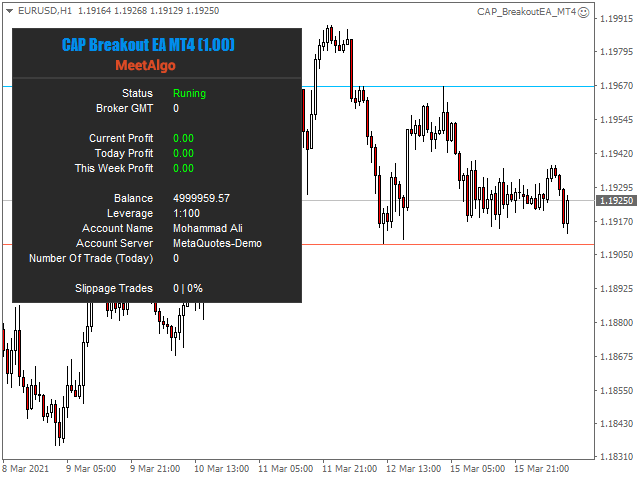
The optional on-chart display shows EA status, broker time, account information and trading activity. Configure its position and text size to suit your chart.
See EA configuration settings and the dashboard guide.
Before You Start
- Choose the correct MT4 or MT5 edition and review the Breakout EA user guide.
- Configure the indicator or pattern settings, entry mode, trading direction and initial lot size.
- Set your entry restrictions and exit rules. Leave optional recovery features disabled unless they are part of a strategy you have tested.
- Check broker symbol names, terminal time and any news-download permissions.
- Backtest and forward-test on demo using your intended broker conditions. Review drawdown and execution behavior, not only net profit.
For more input explanations, use our Common Function Glossary. Trading financial instruments involves a high level of risk and may not be suitable for all investors. Past performance is not indicative of future results. MeetAlgo provides automated trading software and tools for educational and automation purposes only. MeetAlgo does not provide investment advice, portfolio management services, or any regulated financial services. Always consult a licensed financial advisor before making trading decisions.
Custom Development
Need entry rules, filters or trade-management behavior beyond the standard Breakout EA setup? MeetAlgo offers custom development for modifications to an existing EA or a new trading system built around your requirements. Share your platform, entry and exit rules, risk controls and examples so we can assess the scope.
Request a custom development quote.
White Label Service
Want to offer a trading tool under your own brand? Contact MeetAlgo to discuss white-label customization for Breakout EA. Tell us about your branding and distribution plans so we can confirm the available customization, redistribution permissions, licensing terms and project scope.
Discuss your white-label project.
Any Questions?
Not sure which edition, entry mode or management setting fits your intended setup? Send us your platform, EA version, broker symbol and a short description of what you want the EA to do. Screenshots of the relevant inputs can help us understand your question.
Contact MeetAlgo support or start with the Breakout EA user guide.

